
Materials
Materials
Materials
This team conducts research into acoustic propagation in complex media (metamaterials, phonic crystals, granular, inhomogeneous, nonlinear, porous, etc.). This work focuses on fundamental aspects: wave-material interactions (nonlinear acoustics, study of energy transfer, coupling, damage, wave control, inverse problem-solving, signal processing, etc.).
This work also extends to applications such as property identification, imaging, implementation of diagnostic tools, sound absorption, wave control, non-destructive evaluation and testing).
Research Operations
Acoustics and Mechanics of Porous Materials
This research operation studies the acoustical and mechanical properties of porous and meta-porous materials used in various acoustic applications.
It includes various topics: anisotropic porous materials with property gradients, numerical methods for porous and metaporous materials, experimental characterization methods, (e.g., SLATCoW method, Spatial LAplace Transform for Complex Wavenumber recovery), phononic crystals and hyperuniform media, plates/zero density and doping, critical coupling, slow wave and perfect absorption, metadiffusers and thin structures for sound diffusion, nonlocal acoustic description of properties inspired by nonlocal electromagnetism.
%20Mat%C3%A9riaux%20Poreux%20-%20Image%201.png) Méthode SLATCoW : (Geslain et al., J. Appl. Phys. 120: 135107, (2016))
Méthode SLATCoW : (Geslain et al., J. Appl. Phys. 120: 135107, (2016))
%20Mat%C3%A9riaux%20Poreux%20-%20Image%202.png) Metasurfaces : (N Jiménez, TJ Cox, V Romero-García, JP Groby, Metadiffusers: Deep-subwavelength sound diffusers, Sci. Rep. 7: 5389, (2017))
Metasurfaces : (N Jiménez, TJ Cox, V Romero-García, JP Groby, Metadiffusers: Deep-subwavelength sound diffusers, Sci. Rep. 7: 5389, (2017))
Elastic waves in complex media
Opto-Acoustics and Laser Ultrasonics
The aim of opto-acoustics research is to introduce innovative methods for generating and detecting acoustic waves using lasers, for acoustic assessment and non-destructive testing of materials and structures.

Here, the role played by the piezoelectric transducer in traditional ultrasonic measurements is assigned to a laser, but the latter can play this role remotely and without any contact with the materials. If required, sound excitation and detection can be very local (down to the micron scale, the diameter of the focused laser beam) or, on the contrary, can rapidly and optically scan large surfaces (up to a few meters).
In addition to other frequency ranges accessible by traditional methods, opto-acoustics gives access to hypersonic frequencies of acoustic waves (above 1 GHz). In particular, acoustic waves with frequencies above 10 GHz have wavelengths shorter than the micrometer in solids. This makes laser-generated and detected hypersonics a unique tool for the non-destructive evaluation of nanocrystalline materials and nanostructures, as well as for three-dimensional imaging inside continuously inhomogeneous media with nanometer-scale axial resolution.
The contactless principle of this technique makes it particularly suitable for evaluating materials in hostile environments, such as very high temperatures and/or very high pressures, making it a very interesting control tool for both fundamental research and industrial applications.
Ultrasonics
Through both fundamental and applied approaches, this research operation is mainly focused on the development of ultrasonic methods for the non-destructive evaluation and testing (NDET) of materials.
Research activities aim to contribute to a better understanding of the linear and non-linear interactions between ultrasonic waves and complex solids, bringing together different approaches implemented both theoretically and experimentally:
-
Ultrasonic and guided waves in solids and biological media
-
Acoustic emission for characterization of structural materials,
-
Non-linear acoustics and CODA wave interferometry for NDET,
-
Mechanical solicitation for the characterization of composite materials.
This team comprises 10 permanents researchers.
It also has number of specific features: (i) the permanent staff involved are spread across different sites (UFR S&T, ENSIM, IUT, ESEO and CTTM), (ii) the approaches proposed are diverse in terms of both the methods used and the materials applied. Finally, it's worth noting the federative nature of the NDET theme at LAUM, which involves 9 other colleagues to varying degrees in the work carried out here. On a national scale, in addition to its academic collaborations (e.g. the ECND-PdL and FANO laboratories), the team has strong industrial collaborations. On a regional scale, the collective emergence project “ECND-PdL” has strengthened the federating character of the NDET theme and resulted in the creation of the GIS ECND-PDL in 2018.
Topics
- Non-destructive testing of roughness using modal wave decoherence, characterization of bonding of rough plates using SH waves.
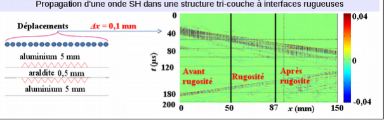

- Émission Acoustique et représentations parcimonieuses pour le suivi d’endommagement de matériaux multicouches.
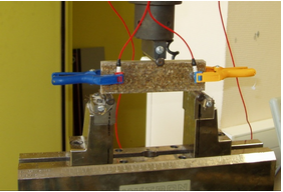
 CND et Matériaux à gradient de propriété.
Collaborations
Through its activities, the Ultrasonics Team is fully in line with the laboratory's NDET transversal axis, which aims to bring together all activities with potential NDET applications. This translates into close collaboration with, in particular, the Transducers team.
Academic collaborations
- FANO and GDR network
- GEPEA, GEnie des Procédés Environnement - Agroalimentaire
- GREMI, Groupe de Recherches sur l’Energétique des Milieux Ionisés
- I2M, Institut de mécanique et d'ingénierie - IMMM, Institut des Molécules et Matériaux du Mans
- IMP, Laboratoire Ingénierie des Matériaux Polymères - INRAE, Institut national de recherche pour l’agriculture, l’alimentation et l’environnement
- IREENA, Institut de recherche en Energie Electrique de Nantes Atlantique - LIMATB, Laboratoire d'Ingénierie des Matériaux de Bretagne
- LMA, Laboratoire de Mécanique et d'Acoustique
- LOMC, Laboratoire Ondes et Milieux Complexes, Le Havre
- LS2N, Laboratoire des Sciences du Numérique de Nantes
- UGE, Université Gustave Eiffel, Nantes
- UTC, Université de Technologie de Compiègne
Industrial partnerships
Almacoustic (Le Mans), AIRBUS, ASTRIUM, BIOMODEX, CEA, DAHER-SOCATA, DB-SAS, EDF, INTRADEF, IRT Jules Verne, MECACHROME, SAFRAN, SANOFI.
Scientific outlook
Research within the OR Ultrasonics will be developed via a dual approach.
Alongside passive and active ultrasonic experimental techniques (airborne and submerged ultrasonic imaging, contact ultrasonics, acoustic emission, nonlinear acoustics), efforts will also be devoted to developing physical models to describe the propagation of ultrasonic waves in complex media (multi-diffusing media, with localized nonlinearities, with porosity, heterogeneous and anisotropic, with roughness). The wealth of experimental techniques under development is an asset for model validation, and provides the data needed for the signal processing algorithms being tested.
In addition, building on the skills acquired in the field of NDT on various materials and assemblies, the OR will also focus on improving models and broadening the scope of application of the various experimental techniques.
More specifically, with regard to investigation methods, promising new avenues using artificial intelligence have been successfully explored (e.g. artificial neural networks for fusion) and will be pursued in the coming years.
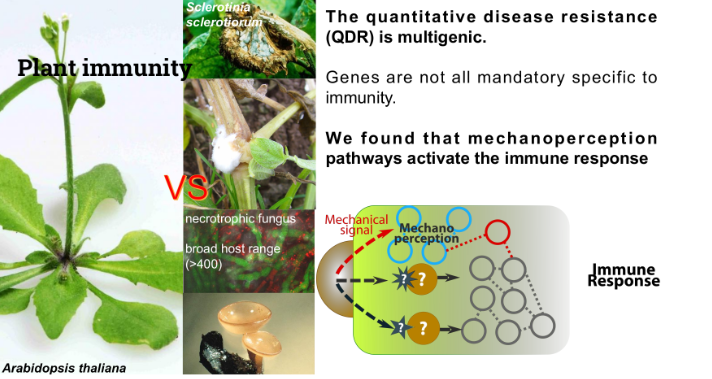 Perception of mechanical waves by plants, coll. INRAE.
At the same time, another approach already underway is to deploy ultrasound methods in biological environments, with a particular focus on data variability, which represents a new challenge for this GOLD, as illustrated in the following figure.
Finally, OR Ultrasons will continue to develop its activities by maintaining and diversifying the already fruitful industrial and academic collaborations, both at regional level (GIS ECND-PdL) and through new national and international collaborations.


